Horizon Kinetics recently released itsQ1 2019 Market Commentary, in which it has shared its expert opinion on several companies in its portfolio. Among those holdings was Kellogg Company (NYSE:K), for which the fund said it is dealing with product saturation, hence it is failing to grow its businesses further. According to the fund, this indicates a downside potential, that shouldn’t be underestimated.
“In 2010, Kellogg produced $12.397 billion of revenue; in 2018, $13.547 billion of revenue. In 2010 it had $2.04 billion of operating profit, and in 2018, $1.71 billion. A standstill. Why did the wide moat franchise fail to grow?
One reason is product saturation. There is simply a limit to the quantity of any product that might be desired by the public. It is extraordinarily difficult for a management or a security analyst to know when this limit will be reached.
The company may also have contributed to its own problems. One might think of a wide moat business in a manner similar to a Class A real estate property: it only remains Class A as long as the owners are prepared to continually invest in maintenance. In a consumer products company, the equivalent of maintenance expense is really advertising and research and development expenditures. R&D is necessary because the product must continually be improved in order to stimulate increased consumer demand. Unfortunately, Kellogg reduced the advertising and R&D over time.
Advertising expenditures declined by 33.4% from 2010 to 2018, and R&D declined by 17.6%. However, these are nominal figures, as are most economic and financial market statistics. If a 3% inflation rate was the experience during those eight years – as for salaries and rents and advertising time and the other inputs for those activities – then the reduction in real terms is 69.0% in advertising expenditure and 49.0% in R&D.
In 2010, gross profit was 43.1% of net sales, while in 2018, it was only 34.9%, which is a decline of over 19% points. The company’s operating profit contracted from 16.4% of net sales in 2010, to 12.6%. The decline in net profit is entirely the consequence of a decline in gross profit.
Essentially, Kellogg’s customers will not abide too high a profit margin. Is this due to the pressure put on Kellogg by retailers, or is it due to customer buying patterns? It is impossible to know without much more data, but we do know that many of the food companies are experiencing declining profit margins.
As a generalization, Kellogg’s profit margins are very high for a U.S. firm, by historical standards. If raw materials costs were to ever increase, as for example grains and sugar, it would be difficult to pass this cost on to the consumer. Like so much else in the past 10 years or so, the price behavior we know is not what history knows.
Agricultural commodity prices experienced a major bear market and they remain depressed. Imagine what an enormous benefit that has been to food and drink manufacturer gross margins. Imagine the impact of a restoration of prior price levels. Kellogg is a wide moat business with little upside, yet with not inconsiderable downside once it is realized that it is no longer a growing business.
A generalized profit margin contraction is a risk for an index buyer. Unfortunately, indexes do not quantify the probability or possible magnitude of that risk for the constituents of the index – it’s not how indexes are managed. Therefore, an important risk factor is not addressed. In which case, for asset allocation purposes, it is not possible to measure forward looking risk and reward – which is the only type that counts.”
Monkey Business Images/Shutterstock.com
Kellogg Company is a Battle Creek, Michigan-based multinational food manufacturer with a market cap of $19.67 billion. Over the past 12 months, the company’s stock lost 5.86%, and on May 9th it had a closing price of $57.79. Kellogg is trading at a P/E ratio of 17.10.
Heading into the first quarter of 2019, a total of 27 of the hedge funds tracked by Insider Monkey were bullish on this stock, a change of 8% from one quarter earlier. By comparison, 24 hedge funds held shares or bullish call options in K a year ago. So, let’s find out which hedge funds were among the top holders of the stock and which hedge funds were making big moves.
Among these funds, Renaissance Technologies held the most valuable stake in Kellogg Company (NYSE:K), which was worth $107.7 million at the end of the third quarter. On the second spot was Pzena Investment Management which amassed $56.7 million worth of shares. Moreover, Citadel Investment Group, GAMCO Investors, and Two Sigma Advisors were also bullish on Kellogg Company (NYSE:K), allocating a large percentage of their portfolios to this stock.
Co-Founder and Research Director at Insider Monkey
When Jeff Bezos said that one breakthrough technology would shape Amazon’s destiny, even Wall Street’s biggest analysts were caught off guard.
Fast forward a year and Amazon’s new CEO Andy Jassy described generative AI as a “once-in-a-lifetime” technology that is already being used across Amazon to reinvent customer experiences.
At the 8th Future Investment Initiative conference, Elon Musk predicted that by 2040 there would be at least 10 billion humanoid robots, with each priced between $20,000 and $25,000.
Do the math. According to Musk, this technology could be worth $250 trillion by 2040.
Put another way, that’s roughly equal to:
175 Teslas
107 Amazons
140 Metas
84 Googles
65 Microsofts
And 55 Nvidias
And here’s the wild part — this $250 trillion wave isn’t tied to one company, but to an entire ecosystem of AI innovators set to reshape the global economy.
It’s a leap so massive, it could reshape how businesses, governments, and consumers operate worldwide.
Even if that $250 trillion figure sounds ambitious, major firms like PwC and McKinsey still see AI unlocking multi-trillion-dollar potential.
How could anything be worth that much?
The answer lies in a breakthrough so powerful it’s redefining how humanity works, learns, and creates.
And this breakthrough has already set off a frenzy among hedge funds and Wall Street’s top investors.
What most investors don’t realize is that one under-owned company holds the key to this $250 trillion revolution.
In fact, Verge argues this company’s supercheap AI technology should concern rivals.
Before I reveal the details, let’s talk about how some of the richest people on the planet are positioning themselves.
Bill Gates sees artificial intelligence as the “biggest technological advance in my lifetime,” more transformative than the internet or personal computer, capable of improving healthcare, education, and addressing climate change.
Larry Ellison — through Oracle, is spending billions on Nvidia chips and partnering with Cohere to embed generative AI across Oracle’s cloud and apps.
Warren Buffett — not known for tech hype — says this breakthrough could have a ‘hugely beneficial social impact.
When billionaires from Silicon Valley to Wall Street line up behind the same idea — you know it’s worth paying attention to.
Even as we admire what Tesla, Nvidia, Alphabet, and Microsoft have built, we believe an even greater opportunity lies elsewhere…
But the real story isn’t Nvidia — it’s a much smaller company quietly improving the critical technology that makes this entire revolution possible.
And judging by what I’m hearing from both Silicon Valley insiders and Wall Street veterans…
This prediction might not be bold at all:
A few years from now, you’ll wish you’d owned this stock.
The best part? You can discover everything about this company and its groundbreaking technology right now.
I’ve compiled everything you need to know about this groundbreaking company in a detailed, members-only report.
Trust me — you’ll want to read this report before putting another dollar into any tech stock.
For a ridiculously low price of just $9.99 a month, you can unlock a year’s worth of in-depth investment research and exclusive insights – that’s less than a single fast food meal!
Here’s why this is a deal you can’t afford to pass up:
• Access to our Detailed Report on this Game-Changing AI Stock: Our in-depth report dives deep into our #1 AI stock’s groundbreaking technology and massive growth potential.
• 11 New Issues of Our Premium Readership Newsletter: You will also receive 11 new issues and at least one new stock pick per month from our monthly newsletter’s portfolio over the next 12 months. These stocks are handpicked by our research director, Dr. Inan Dogan.
• One free upcoming issue of our 70+ page Quarterly Newsletter: A value of $149
• Bonus Reports: Premium access to members-only fund manager video interviews
• Ad-Free Browsing: Enjoy a year of investment research free from distracting banner and pop-up ads, allowing you to focus on uncovering the next big opportunity.
• 30-Day Money-Back Guarantee: If you’re not absolutely satisfied with our service, we’ll provide a full refund within 30 days, no questions asked.
If you’re thinking about getting in, don’t wait – because once Wall Street catches wind of this story, the easy money will be gone.
Space is Limited! Only 1000 spots are available for this exclusive offer. Don’t let this chance slip away – subscribe to our Premium Readership Newsletter today and unlock the potential for a life-changing investment.
Here’s what to do next:
1. Subscribe to our Premium Readership Newsletter for just $9.99 a month. (33% Off – was $14.99).
2. Enjoy a year of ad-free browsing, exclusive access to our in-depth report on the revolutionary AI company, and the upcoming issues of our Premium Readership Newsletter over the next 12 months.
3. Sit back, relax, and know that you’re backed by our ironclad 30-day money-back guarantee.
Don’t miss out on this incredible opportunity! Subscribe now and take control of your AI investment future!
Co-Founder and Research Director at Insider Monkey
My name is Inan Dogan. I’m the co-founder and Research Director of Insider Monkey. I have an important message for you today.
Since March 2017, my stock picks have returned 16.5% annually. Today, I’ve found an opportunity even bigger than my British American Tobacco call.
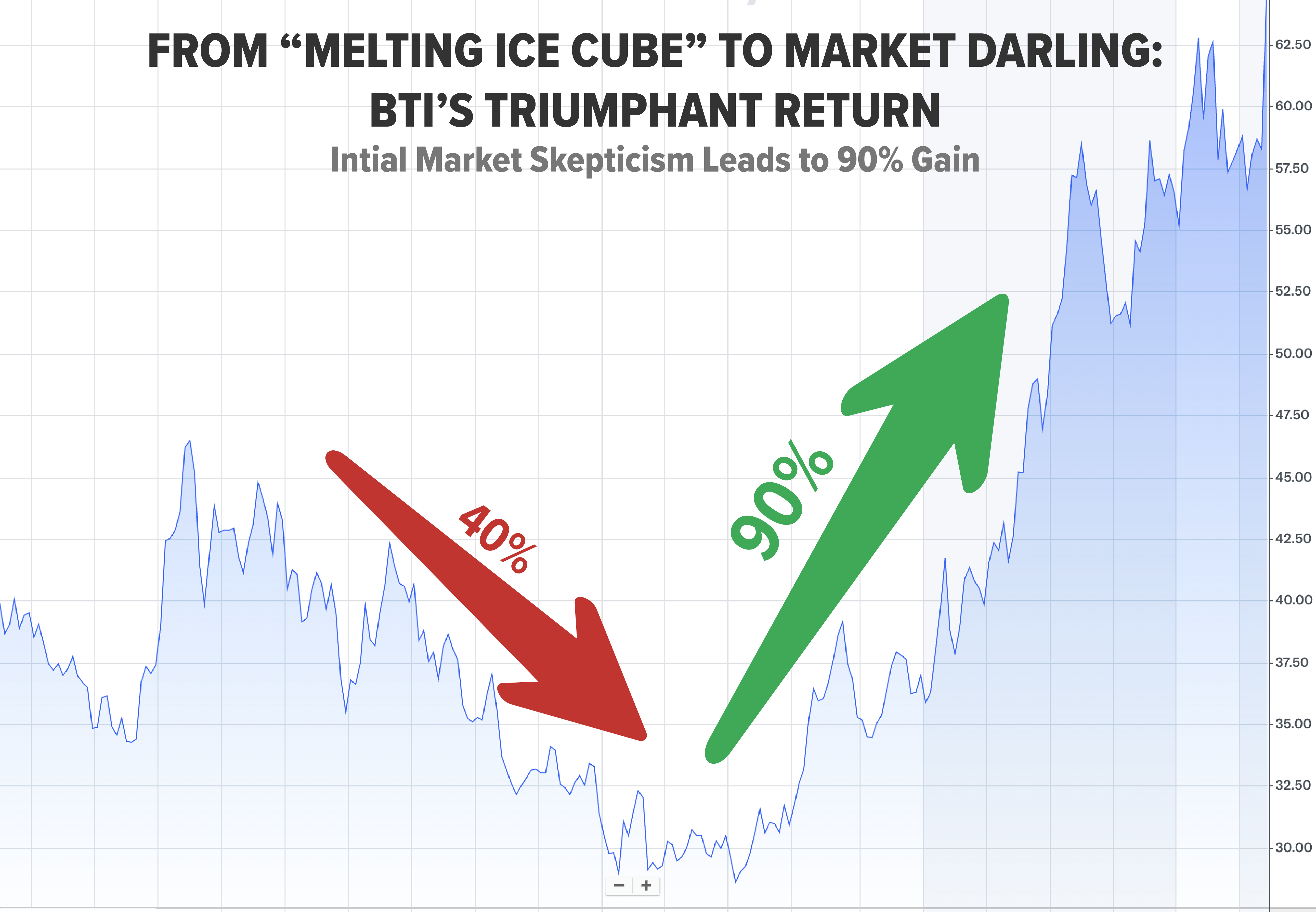
Two years ago, Wall Street wrote off British American Tobacco (BTI) as a “melting ice cube.” The stock had crashed 40% from its peak, and consensus said the business was dying.
We looked under the cover and realized they were wrong.
We alerted our subscribers, and BTI returned 90% in just 16 months.
Now if you had invested just $10,000 in BTI in June 2024, you’d be sitting on $19,000 in October 2025.
Today, we have identified a nearly identical pattern in a digital-first giant trading at $3.
While the market panics over a surface-level revenue decline, our PhD-led research shows management has actually surgically cut $100 million in waste to focus on high-margin growth.
This pattern is a hallmark of our 16.5% annual return track record. The current opportunity offers a 400% upside potential—dwarfing even our 90% BTI return.
Get the ticker for our new “Underdog” pick and the full BTI case study for just 99 cents.
This exclusive offer is for NEW newsletter subscribers ONLY! Join our Premium Readership Newsletter for only $0.99 and become part of a savvy investor community.!
This offer vanishes in 7 days, so don’t miss your chance to lock in market beating returns! Sign up NOW! The monthly newsletter comes with a 30-day, no-risk money-back guarantee. This offer is available to the first 1000 new investors who respond.
Here’s why this is a deal you can’t afford to pass up:
Access to our Detailed Report on this $3 stock with 400% upside potential.
BONUS REPORT on our #1 AI-Robotics Stock with 10000% upside potential: Our in-depth report dives deep into our #1 AI/robotics stock’s groundbreaking technology and massive growth potential.
One New Issue of Our Premium Readership Newsletter: You will also receive one new issue per month and at least one new stock pick per month from our monthly newsletter’s portfolio over the next 12 months. These stocks are handpicked by our research director, Dr. Inan Dogan.
One free upcoming issue of our 70+ page Quarterly Newsletter: A value of $149
Bonus Content: Premium access to members-only fund manager video interviews
Ad-Free Browsing: Enjoy a month of investment research free from distracting banner and pop-up ads, allowing you to focus on uncovering the next big opportunity.
Lifetime Price Guarantee: Your renewal rate will always remain the same as long as your subscription is active.
30-Day Money-Back Guarantee: If you’re not absolutely satisfied with our service, we’ll provide a full refund within 30 days, no questions asked.
Space is Limited! Only 1000 spots are available for this exclusive offer. Don’t let this chance slip away – subscribe to our Premium Readership Newsletter today and unlock the potential for a life-changing investment.
Here’s what to do next:
1. Head over to our website and subscribe to our Premium Readership Newsletter for just $0.99.
2. Enjoy a month of ad-free browsing, exclusive access to our in-depth report on the Trump tariff and nuclear energy company as well as the revolutionary AI-robotics company, and the upcoming issues of our Premium Readership Newsletter.
3. Sit back, relax, and know that you’re backed by our ironclad 30-day money-back guarantee.
Don’t miss out on this incredible opportunity! Subscribe now and take control of your AI investment future!