ASML Holding N.V. (NASDAQ:ASML) and Applied Materials, Inc. (NASDAQ:AMAT) sell different tools, but both compete for the same investor dollar tied to semiconductor capital spending. ASML trades around 31 times forward earnings, while Applied Materials trades near 27 times. That modest premium raises a useful question: how much should investors pay for a near-monopoly?
The distinction matters as leading-edge fabs pour money into AI logic, memory and advanced packaging. TSMC’s High-NA plans recently gave ASML investors a concrete way to test how quickly its next lithography cycle can become revenue. Applied Materials has a broader portfolio, but ASML owns the bottleneck customers cannot easily replace.
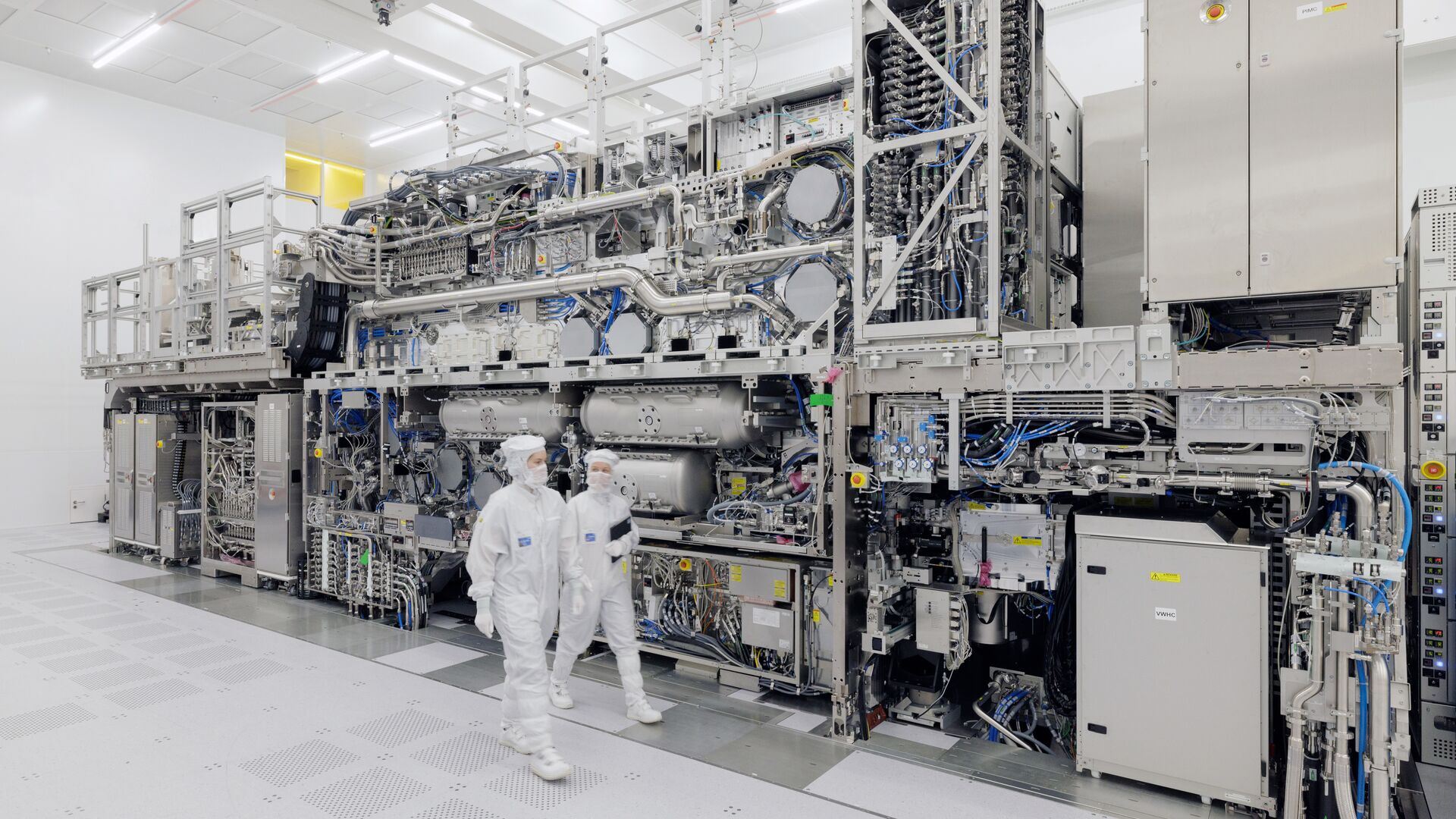
ASML’s moat is narrower and much harder to attack
ASML Holding N.V. generated €9.3 billion of second-quarter sales with a 54% gross margin and €2.9 billion of net income. Management now expects 2026 sales of €43 billion to €45 billion and a 54% to 56% gross margin, while planning substantial increases in low-NA EUV and immersion capacity for 2027.
That visibility reflects a structural advantage. Advanced logic and memory manufacturers cannot produce leading-edge chips at scale without ASML’s EUV systems. The bear case is concentration and geopolitics. A small number of customers drive demand, export controls can limit China sales, and a 31 times forward multiple assumes AI-related fab spending remains strong enough to absorb expanded capacity.
Applied Materials spreads its exposure across more process steps
Applied Materials, Inc. reported record fiscal third-quarter revenue of $9.12 billion, up 25%, while GAAP gross margin rose to 50.3%. Operating margin reached 33.7%, EPS increased 43%, and non-GAAP free cash flow was $2.33 billion. Its equipment participates in deposition, materials engineering, advanced packaging and other steps that become more important as chip structures grow more complex.
That breadth lowers dependence on one architecture and gives Applied Materials more ways to benefit when spending shifts between logic, memory and packaging, but it also means Applied Materials lacks ASML’s single irreplaceable product category. Competition is stronger across its portfolio, and 28% of quarterly revenue came from China, leaving its own export-control exposure. The cheaper multiple compensates investors for some of that difference.
Institutional ownership remains broad in both names. Insider Monkey tracked 140 ASML holders in Q2, up from 133 in Q1, while Fisher Asset Management increased its stake about 3% to 4.74 million shares. Applied Materials slipped to 137 holders from 138, and Coatue Management cut its position roughly 20%. AMAT short interest stood at 15.62 million shares on August 31, around 1.97% of float with 2.3 days to cover.
Applied Materials is cheaper and more diversified. ASML is the better risk-adjusted stock because the roughly four-turn earnings premium looks modest for a technological bottleneck with stronger pricing power and extraordinary replacement difficulty.
 Hedge Fund Resource Center