Why modern portfolios are no longer choosing between safety and speed: they are demanding both.
In mid-January, gold surged past 4,600 USD per ounce while bitcoin dropped below 92,000 USD, remaining volatile but still holding up well YTD. Both assets are attracting capital, framing them as opposites, but something more nuanced is unfolding. Traders are no longer choosing between gold and crypto. They are allocating capital to both. The question is no longer which asset “wins.” The real question is why capital is flowing in both directions simultaneously and what that dual demand reveals about the state of global markets in 2026.
Why gold is breaking records
Gold’s move above 4,600 USD per ounce reflects more than short‑term fear. Central bank behaviour has shifted structurally. For the first time in decades, gold now represents a larger share of global reserve allocations than US Treasuries, a notable signal about how sovereign institutions are thinking about long‑term monetary stability.
Institutional participation has followed. Exchange‑traded funds saw renewed inflows through 2025, while central bank purchases continued at elevated levels. This is not momentum chasing. It is a strategic allocation. In an environment shaped by geopolitical tensions, fiscal sustainability questions, and uncertainty about the long‑term trajectory of interest rates, gold serves as both a hedge and a reserve asset with no counterparty risk.
Lower interest rate expectations further support the metal. As yields fall, the opportunity cost of holding non‑yielding assets declines, making gold relatively more attractive. At the same time, a softer US dollar mechanically boosts gold demand outside the United States, reinforcing its role as a global store of value rather than a purely defensive trade.
In this context, gold is not just an inflation hedge. It has become a barometer of policy uncertainty and systemic risk—a way for portfolios to insure against scenarios that traditional fixed income no longer covers as cleanly.
Why crypto remains attractive despite volatility
Bitcoin’s volatility has not prevented capital from returning. Trading well below its late‑2025 highs but still structurally elevated, bitcoin reflects a different kind of demand. Unlike gold, its appeal is not stability. It is responsiveness.
Crypto markets remain tightly linked to liquidity conditions and risk appetite. Bitcoin does not behave like a consistent safe haven. During acute stress, it can sell off alongside equities. But when liquidity expectations improve or risk appetite rebuilds, it often rebounds faster and with greater magnitude than traditional assets.
That dual nature positions crypto as a performance instrument rather than a hedge. Traders allocate capital to it when they anticipate improving financial conditions, want exposure to volatility, or seek asymmetric upside. Institutional access has broadened, and market infrastructure has matured, but crypto retains the characteristics that make it attractive to investors willing to tolerate higher variability in pursuit of higher potential returns.
The mixed portfolio approach
The most telling development is not gold’s rally or crypto’s resilience in isolation. It is that traders increasingly hold both. This reflects a portfolio construction approach designed to navigate a multi‑regime environment.
Gold provides ballast when uncertainty rises. Crypto provides convexity when conditions improve. Holding both is not contradictory. It is a recognition that markets in 2026 are not defined by a single dominant narrative. Risk can rise suddenly, but liquidity conditions can also ease quickly. A portfolio that prepares only for one outcome is exposed to the other.
This blended positioning suggests that traders are not just managing volatility, but regime uncertainty. They are hedging systemic risk while remaining positioned for performance. That shift points to a more sophisticated form of risk management—one that treats diversification as a dynamic balance between defensive and offensive exposures.
Terence Hove, senior market analyst at Exness, notes that execution quality becomes critical when moving between assets with very different volatility profiles. “Cross‑asset strategies only work when trading conditions are reliable. During macro events, spreads need to remain stable, execution needs to be precise, and slippage needs to be controlled. Traders shifting between gold and crypto during volatile periods need platforms capable of handling both speed and complexity.”
This dual allocation also raises a practical constraint that rarely gets discussed: rotating between defensive and performance assets only works if trading conditions remain consistent across both. Otherwise, the act of switching becomes a hidden cost in itself. This is where broker execution quality becomes part of portfolio construction.
For example, Exness’ BTCUSD spreads remained at their minimum levels 99.98% of the time², while ETHUSD spreads have been reduced by 67%³. In fast markets, that cross-asset consistency allows traders to adjust exposure without execution risk becoming the primary variable.
What this reveals about market psychology
The simultaneous demand for gold and crypto signals a fragmented risk backdrop. Markets are not uniformly risk‑on or risk‑off. Instead, participants are preparing for multiple paths at once.
Gold demand reflects caution around policy credibility, currency stability, and geopolitical risk. Crypto demand reflects expectations that liquidity cycles and structural adoption trends can still drive performance. Both narratives can coexist because today’s macro environment supports both caution and opportunism.
In that sense, the market is not choosing between fear and performance. It is pricing both. The coexistence of gold strength and sustained crypto interest suggests that investors are building portfolios that can absorb shocks while still participating in upside when conditions allow.
As 2026 unfolds, the relationship between gold and crypto will likely remain fluid. Their correlation will shift with liquidity, policy expectations, and market stress. Traders who understand the distinct role each asset plays, and who operate in trading environments designed to maintain stable conditions across asset classes, will be better positioned to navigate the volatility ahead.
¹ Stable spreads for BTCUSD CFDs on the Standard account remained at their minimum levels for over 99.98% of the time from 23 June to 3 July 2025.
2 67% reduced ETHUSD spreads claim refers to a spread reduction on ETHUSD CFDs on Standard accounts, comparing spreads from 22 June 2025–30 June 2025 relative to the November 2024 average.
Co-Founder and Research Director at Insider Monkey
When Jeff Bezos said that one breakthrough technology would shape Amazon’s destiny, even Wall Street’s biggest analysts were caught off guard.
Fast forward a year and Amazon’s new CEO Andy Jassy described generative AI as a “once-in-a-lifetime” technology that is already being used across Amazon to reinvent customer experiences.
At the 8th Future Investment Initiative conference, Elon Musk predicted that by 2040 there would be at least 10 billion humanoid robots, with each priced between $20,000 and $25,000.
Do the math. According to Musk, this technology could be worth $250 trillion by 2040.
Put another way, that’s roughly equal to:
175 Teslas
107 Amazons
140 Metas
84 Googles
65 Microsofts
And 55 Nvidias
And here’s the wild part — this $250 trillion wave isn’t tied to one company, but to an entire ecosystem of AI innovators set to reshape the global economy.
It’s a leap so massive, it could reshape how businesses, governments, and consumers operate worldwide.
Even if that $250 trillion figure sounds ambitious, major firms like PwC and McKinsey still see AI unlocking multi-trillion-dollar potential.
How could anything be worth that much?
The answer lies in a breakthrough so powerful it’s redefining how humanity works, learns, and creates.
And this breakthrough has already set off a frenzy among hedge funds and Wall Street’s top investors.
What most investors don’t realize is that one under-owned company holds the key to this $250 trillion revolution.
In fact, Verge argues this company’s supercheap AI technology should concern rivals.
Before I reveal the details, let’s talk about how some of the richest people on the planet are positioning themselves.
Bill Gates sees artificial intelligence as the “biggest technological advance in my lifetime,” more transformative than the internet or personal computer, capable of improving healthcare, education, and addressing climate change.
Larry Ellison — through Oracle, is spending billions on Nvidia chips and partnering with Cohere to embed generative AI across Oracle’s cloud and apps.
Warren Buffett — not known for tech hype — says this breakthrough could have a ‘hugely beneficial social impact.
When billionaires from Silicon Valley to Wall Street line up behind the same idea — you know it’s worth paying attention to.
Even as we admire what Tesla, Nvidia, Alphabet, and Microsoft have built, we believe an even greater opportunity lies elsewhere…
But the real story isn’t Nvidia — it’s a much smaller company quietly improving the critical technology that makes this entire revolution possible.
And judging by what I’m hearing from both Silicon Valley insiders and Wall Street veterans…
This prediction might not be bold at all:
A few years from now, you’ll wish you’d owned this stock.
The best part? You can discover everything about this company and its groundbreaking technology right now.
I’ve compiled everything you need to know about this groundbreaking company in a detailed, members-only report.
Trust me — you’ll want to read this report before putting another dollar into any tech stock.
For a ridiculously low price of just $9.99 a month, you can unlock a year’s worth of in-depth investment research and exclusive insights – that’s less than a single fast food meal!
Here’s why this is a deal you can’t afford to pass up:
• Access to our Detailed Report on this Game-Changing AI Stock: Our in-depth report dives deep into our #1 AI stock’s groundbreaking technology and massive growth potential.
• 11 New Issues of Our Premium Readership Newsletter: You will also receive 11 new issues and at least one new stock pick per month from our monthly newsletter’s portfolio over the next 12 months. These stocks are handpicked by our research director, Dr. Inan Dogan.
• One free upcoming issue of our 70+ page Quarterly Newsletter: A value of $149
• Bonus Reports: Premium access to members-only fund manager video interviews
• Ad-Free Browsing: Enjoy a year of investment research free from distracting banner and pop-up ads, allowing you to focus on uncovering the next big opportunity.
• 30-Day Money-Back Guarantee: If you’re not absolutely satisfied with our service, we’ll provide a full refund within 30 days, no questions asked.
If you’re thinking about getting in, don’t wait – because once Wall Street catches wind of this story, the easy money will be gone.
Space is Limited! Only 1000 spots are available for this exclusive offer. Don’t let this chance slip away – subscribe to our Premium Readership Newsletter today and unlock the potential for a life-changing investment.
Here’s what to do next:
1. Subscribe to our Premium Readership Newsletter for just $9.99 a month. (33% Off – was $14.99).
2. Enjoy a year of ad-free browsing, exclusive access to our in-depth report on the revolutionary AI company, and the upcoming issues of our Premium Readership Newsletter over the next 12 months.
3. Sit back, relax, and know that you’re backed by our ironclad 30-day money-back guarantee.
Don’t miss out on this incredible opportunity! Subscribe now and take control of your AI investment future!
Co-Founder and Research Director at Insider Monkey
My name is Inan Dogan. I’m the co-founder and Research Director of Insider Monkey. I have an important message for you today.
Since March 2017, my stock picks have returned 16.5% annually. Today, I’ve found an opportunity even bigger than my British American Tobacco call.
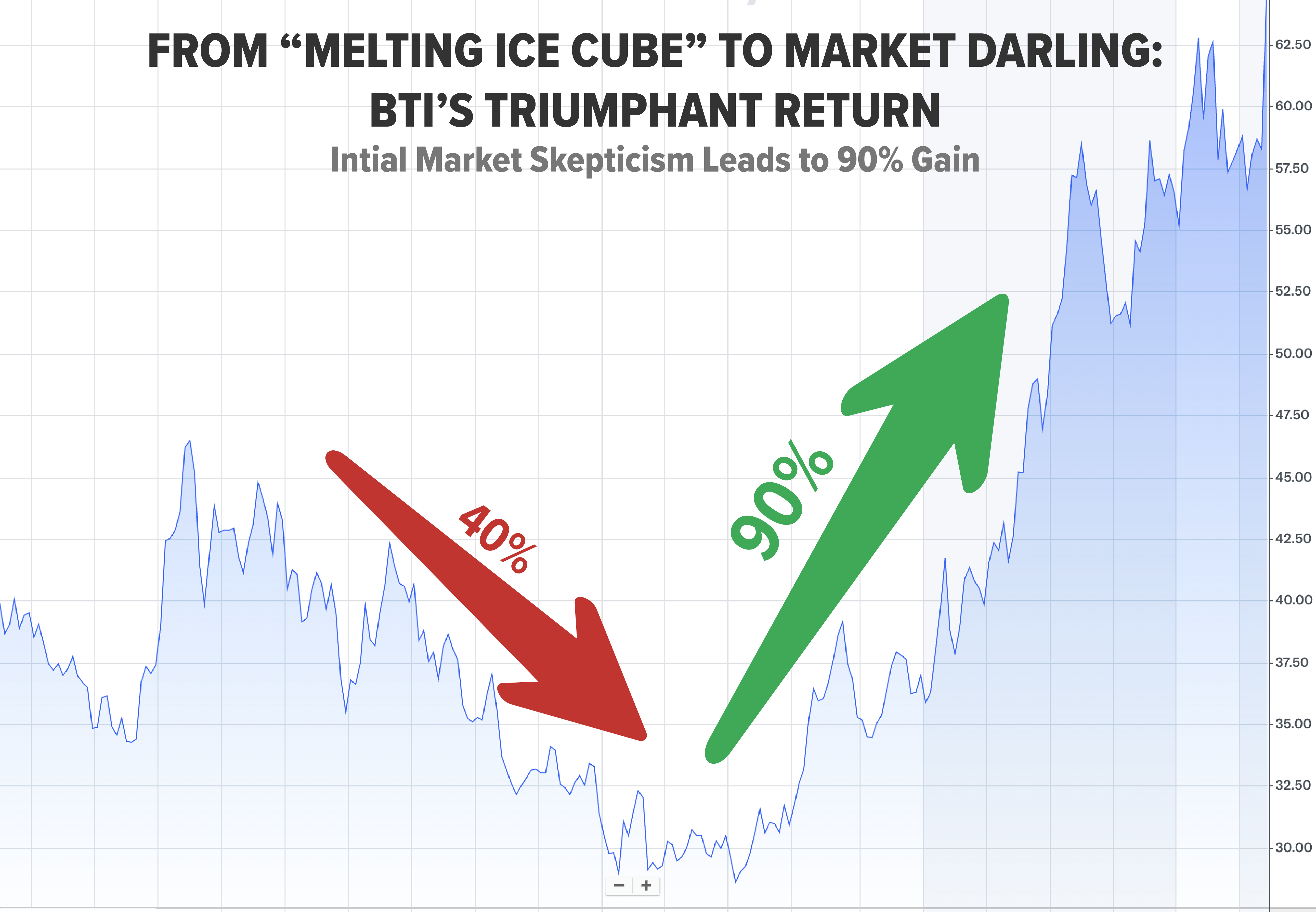
Two years ago, Wall Street wrote off British American Tobacco (BTI) as a “melting ice cube.” The stock had crashed 40% from its peak, and consensus said the business was dying.
We looked under the cover and realized they were wrong.
We alerted our subscribers, and BTI returned 90% in just 16 months.
Now if you had invested just $10,000 in BTI in June 2024, you’d be sitting on $19,000 in October 2025.
Today, we have identified a nearly identical pattern in a digital-first giant trading at $3.
While the market panics over a surface-level revenue decline, our PhD-led research shows management has actually surgically cut $100 million in waste to focus on high-margin growth.
This pattern is a hallmark of our 16.5% annual return track record. The current opportunity offers a 400% upside potential—dwarfing even our 90% BTI return.
Get the ticker for our new “Underdog” pick and the full BTI case study for just 99 cents.
This exclusive offer is for NEW newsletter subscribers ONLY! Join our Premium Readership Newsletter for only $0.99 and become part of a savvy investor community.!
This offer vanishes in 7 days, so don’t miss your chance to lock in market beating returns! Sign up NOW! The monthly newsletter comes with a 30-day, no-risk money-back guarantee. This offer is available to the first 1000 new investors who respond.
Here’s why this is a deal you can’t afford to pass up:
Access to our Detailed Report on this $3 stock with 400% upside potential.
BONUS REPORT on our #1 AI-Robotics Stock with 10000% upside potential: Our in-depth report dives deep into our #1 AI/robotics stock’s groundbreaking technology and massive growth potential.
One New Issue of Our Premium Readership Newsletter: You will also receive one new issue per month and at least one new stock pick per month from our monthly newsletter’s portfolio over the next 12 months. These stocks are handpicked by our research director, Dr. Inan Dogan.
One free upcoming issue of our 70+ page Quarterly Newsletter: A value of $149
Bonus Content: Premium access to members-only fund manager video interviews
Ad-Free Browsing: Enjoy a month of investment research free from distracting banner and pop-up ads, allowing you to focus on uncovering the next big opportunity.
Lifetime Price Guarantee: Your renewal rate will always remain the same as long as your subscription is active.
30-Day Money-Back Guarantee: If you’re not absolutely satisfied with our service, we’ll provide a full refund within 30 days, no questions asked.
Space is Limited! Only 1000 spots are available for this exclusive offer. Don’t let this chance slip away – subscribe to our Premium Readership Newsletter today and unlock the potential for a life-changing investment.
Here’s what to do next:
1. Head over to our website and subscribe to our Premium Readership Newsletter for just $0.99.
2. Enjoy a month of ad-free browsing, exclusive access to our in-depth report on the Trump tariff and nuclear energy company as well as the revolutionary AI-robotics company, and the upcoming issues of our Premium Readership Newsletter.
3. Sit back, relax, and know that you’re backed by our ironclad 30-day money-back guarantee.
Don’t miss out on this incredible opportunity! Subscribe now and take control of your AI investment future!