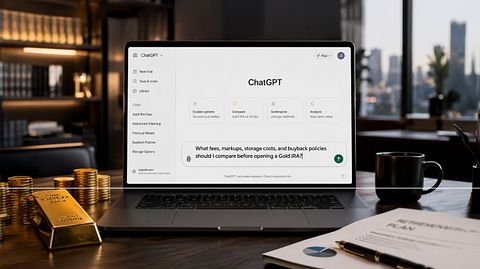
ChatGPT can turn weeks of gold IRA research into a single afternoon, but only if you know the right questions to ask. Some of the biggest red flags in the industry include commissioned sales tactics, overpriced “limited-mintage” coins, hidden fees, weak buyback programs, and fear-driven marketing designed to rush investors into decisions. Used correctly, ChatGPT can help you compare gold IRA companies, uncover pros and cons, identify potential warning signs, and even provide source-backed research to verify claims. Below, you’ll find a copy-and-paste prompt along with a full breakdown of how to use ChatGPT to research gold IRA companies before you commit.
If ChatGPT existed back then, this story would have never happened.
In 2020, a 77-year-old retired teacher in California wired $300,000 from her IRA to a gold IRA company she’d seen advertised on cable news. The salesman told her the dollar was about to collapse and that physical gold was the only safe place left. He sold her “$300,000” of “limited edition” coins at nearly double their melt value.
When she tried to sell it two years later to pay medical bills, the coins were worth about $180,000. The $120,000 difference had disappeared into commission, markup, and fees, most of it gone within the first year. She didn’t get defrauded in any legal sense. She got sold.
Stories like hers aren’t uncommon. The gold IRA industry is built this way on purpose, the pitch is designed to pressure you into a sale before you really know what you’re buying. Fear, urgency, a “limited-mintage” coin, and a price you never really got to question. Same script, different customer.
We Created a Simple Copy/Paste ChatGPT Prompt For Your Research
These days, many people use ChatGPT the same way they use Google, to research companies before making important decisions. And when it comes to a Gold IRA, it’s a smart way to compare your options before talking to a salesperson. The key is asking the right questions. If you tell ChatGPT which companies to compare and what factors matter most to you, like fees, reviews, or buyback policies, you’ll get a much more useful side-by-side comparison instead of a generic summary.
Paste the copy-and-paste prompt below into ChatGPT, swap in the company names you want to research, and review the results with a healthy amount of skepticism.
The Copy/Paste Prompt
Help me research gold IRA companies before I open an account. I’m considering [COMPANY]. Pull current info from the web and tell me:
Business model – Do they use commissioned salespeople? Do they push “limited-mintage” or exclusive coins, or standard bullion? What’s the typical markup over spot price?
Fees – Setup, annual, storage, transaction, and liquidation fees. Flat or percentage-based? Anything buried in fine print?
Platform – Do they have a platform where you can buy and sell on your own? Do you have to call to buy metals?
Buybacks – Is there a formal buyback program? What spread below the spot do they pay? Any complaints about customers struggling to sell? Can you sell with the push of a button?
Complaints – BBB profile, FTC or state actions, recurring themes in Trustpilot and Reddit reviews. Make sure you can look at the negative ones and if you notice a pattern.
Marketing tone – Fear-based? Currency collapse narratives? Paid celebrity endorsers?
Don’t soften it. Cite your sources.
What to Do With the AI Answer
Treat the ChatGPT output as a research draft, not a verdict. Use it to build a shortlist of two or three companies worth a direct conversation. Then, before you call any of them, do three things.
Pull up each company’s current fee schedule on their actual website and confirm the numbers.
Read the most recent one-star reviews on Trustpilot and Google. Pattern-match. A company with thousands of positive reviews will always have some unhappy customers; that’s noise. What you’re looking for is recurring themes – “my investments were valued much less,” “I couldn’t sell my metals right away” “pressured into coins I didn’t want.” Those are signals. Cross-reference against the Better Business Bureau profile and check the FTC’s consumer complaint database for any formal actions.
Call customer support with a specific, boring question. Something like: “What’s the exact spread below spot you pay on buybacks right now?” How they answer, or deflect, tells you a lot. A transparent company gives you a number. A sales-driven company redirects the conversation to what you should buy.
What to Watch For Before You Wire a Dollar
Read the reviews, especially the negative ones
One thing most people miss when researching Gold IRA companies is when the positive reviews are written.
Most five-star reviews happen right after someone opens an account, rolls over their retirement funds, and buys metals. At that stage, the customer is usually reviewing the onboarding experience, not the long-term investment outcome. The representative was friendly, the rollover went smoothly, and everything felt professional. That’s why nearly every Gold IRA company has thousands of glowing reviews.
But the more important reviews often show up months or years later, when customers try to sell their metals, transfer out, understand the true value of their holdings, or get access to their money.
That’s where patterns start to appear.
You’re not looking for one angry customer. You’re looking for the same complaints showing up again and again across different websites and reviewers. Phrases like:
“I couldn’t sell my metals easily”
“The markups were never fully explained”
“I was pushed into expensive coins”
“The value was much lower than I expected”
“It took weeks to get my money”
Those patterns matter far more than hundreds of generic five-star onboarding reviews.
A company’s marketing tells you what they want you to believe. Their one-star and two-star reviews often tell you what customers experienced later on. Check Trustpilot, Google Reviews, the BBB, Reddit, and FTC complaints. If you keep seeing the same issues across multiple sources, pay attention.
Commissioned Salespeople
This is the first and biggest tell. If a gold IRA company pays its reps on commission, every conversation you have with them is shaped by that incentive. The rep doesn’t make money when you buy a low-markup American Eagle at a fair price. They make money when they talk you into a “limited-mintage” coin that carries a much higher margin than spot price. You will hear phrases like “historically, the value of these metals go up over time because of their limited mintage,” “limited supply with high demand is a benefit to you,” and “a lot of my clients are putting these coins into their portfolio.” These are scripts.
A legitimate platform doesn’t need a salesperson to close you. The product stands on its own pricing.
Markups on Coins (Especially “Limited-Edition” Coins)
The spot price of gold is public. You can pull it up on Kitco or any financial site in about three seconds. The question is: how far above spot is the company selling you the physical metal?
Bullion coins from major mints, American Eagles or Canadian Maple Leafs, typically carry a small premium over spot to cover minting and dealer margin. That’s normal. What’s not normal is paying 30, 40, or even 50 percent over spot for a “limited edition” coin that the salesperson claims will appreciate faster than regular bullion. It almost never does. When you try to sell those coins, buyers price them based on melt value, not the collector premium you paid. That premium is gone the moment the coin ships.
The Buyback Problem
This is the part most Gold IRA companies barely talk about: selling.
Buying metals is easy. Selling them is where people discover what they actually own and what it’s really worth.
Some companies will gladly sell you coins at huge premiums, then offer far less when you try to sell them back. Others make you call a representative just to get a quote, delay the process, or pressure you not to liquidate at all. By the time the spread, markups, and discounts hit, some investors realize they lost 50% or more before the metal even had a chance to move.
Pay attention to how a company handles transactions. If every buy and sell requires a phone call with a salesperson, that’s usually not about convenience. It’s a sales funnel.
A modern platform should let you see pricing clearly and buy or sell directly from your account without needing someone to “talk you through it” every time.
One Last Thing
ChatGPT is a tool. It will not save you from a bad decision if you’re determined to make one, and it will not replace the work of reading a custodial agreement before you sign it. But used well, it compresses the research phase from weeks to an afternoon and gives you a structured way to compare companies that are specifically designed to be hard to compare.
The gold IRA industry has spent decades counting on information asymmetry. You no longer have to accept that asymmetry. Ask better questions. Demand sources. Verify numbers. And never, ever buy a coin from someone whose paycheck depends on you buying it.
Share
The $250 Trillion AI Hype is Real. A few years from now, you’ll probably wish you’d bought this stock.
Co-Founder and Research Director at Insider Monkey
When Jeff Bezos said that one breakthrough technology would shape Amazon’s destiny, even Wall Street’s biggest analysts were caught off guard.
Fast forward a year and Amazon’s new CEO Andy Jassy described generative AI as a “once-in-a-lifetime” technology that is already being used across Amazon to reinvent customer experiences.
At the 8th Future Investment Initiative conference, Elon Musk predicted that by 2040 there would be at least 10 billion humanoid robots, with each priced between $20,000 and $25,000.
Do the math. According to Musk, this technology could be worth $250 trillion by 2040.
Put another way, that’s roughly equal to:
175 Teslas
107 Amazons
140 Metas
84 Googles
65 Microsofts
And 55 Nvidias
And here’s the wild part — this $250 trillion wave isn’t tied to one company, but to an entire ecosystem of AI innovators set to reshape the global economy.
It’s a leap so massive, it could reshape how businesses, governments, and consumers operate worldwide.
Even if that $250 trillion figure sounds ambitious, major firms like PwC and McKinsey still see AI unlocking multi-trillion-dollar potential.
How could anything be worth that much?
The answer lies in a breakthrough so powerful it’s redefining how humanity works, learns, and creates.
And this breakthrough has already set off a frenzy among hedge funds and Wall Street’s top investors.
What most investors don’t realize is that one under-owned company holds the key to this $250 trillion revolution.
In fact, Verge argues this company’s supercheap AI technology should concern rivals.
Before I reveal the details, let’s talk about how some of the richest people on the planet are positioning themselves.
Bill Gates sees artificial intelligence as the “biggest technological advance in my lifetime,” more transformative than the internet or personal computer, capable of improving healthcare, education, and addressing climate change.
Larry Ellison — through Oracle, is spending billions on Nvidia chips and partnering with Cohere to embed generative AI across Oracle’s cloud and apps.
Warren Buffett — not known for tech hype — says this breakthrough could have a ‘hugely beneficial social impact.
When billionaires from Silicon Valley to Wall Street line up behind the same idea — you know it’s worth paying attention to.
Even as we admire what Tesla, Nvidia, Alphabet, and Microsoft have built, we believe an even greater opportunity lies elsewhere…
But the real story isn’t Nvidia — it’s a much smaller company quietly improving the critical technology that makes this entire revolution possible.
And judging by what I’m hearing from both Silicon Valley insiders and Wall Street veterans…
This prediction might not be bold at all:
A few years from now, you’ll wish you’d owned this stock.
The best part? You can discover everything about this company and its groundbreaking technology right now.
I’ve compiled everything you need to know about this groundbreaking company in a detailed, members-only report.
Trust me — you’ll want to read this report before putting another dollar into any tech stock.
For a ridiculously low price of just $9.99 a month, you can unlock a year’s worth of in-depth investment research and exclusive insights – that’s less than a single fast food meal!
Here’s why this is a deal you can’t afford to pass up:
• Access to our Detailed Report on this Game-Changing AI Stock: Our in-depth report dives deep into our #1 AI stock’s groundbreaking technology and massive growth potential.
• 11 New Issues of Our Premium Readership Newsletter: You will also receive 11 new issues and at least one new stock pick per month from our monthly newsletter’s portfolio over the next 12 months. These stocks are handpicked by our research director, Dr. Inan Dogan.
• One free upcoming issue of our 70+ page Quarterly Newsletter: A value of $149
• Bonus Reports: Premium access to members-only fund manager video interviews
• Ad-Free Browsing: Enjoy a year of investment research free from distracting banner and pop-up ads, allowing you to focus on uncovering the next big opportunity.
• 30-Day Money-Back Guarantee: If you’re not absolutely satisfied with our service, we’ll provide a full refund within 30 days, no questions asked.
If you’re thinking about getting in, don’t wait – because once Wall Street catches wind of this story, the easy money will be gone.
Space is Limited! Only 1000 spots are available for this exclusive offer. Don’t let this chance slip away – subscribe to our Premium Readership Newsletter today and unlock the potential for a life-changing investment.
Here’s what to do next:
1. Subscribe to our Premium Readership Newsletter for just $9.99 a month. (33% Off – was $14.99).
2. Enjoy a year of ad-free browsing, exclusive access to our in-depth report on the revolutionary AI company, and the upcoming issues of our Premium Readership Newsletter over the next 12 months.
3. Sit back, relax, and know that you’re backed by our ironclad 30-day money-back guarantee.
Don’t miss out on this incredible opportunity! Subscribe now and take control of your AI investment future!
Co-Founder and Research Director at Insider Monkey
My name is Inan Dogan. I’m the co-founder and Research Director of Insider Monkey. I have an important message for you today.
Since March 2017, my stock picks have returned 16.5% annually. Today, I’ve found an opportunity even bigger than my British American Tobacco call.
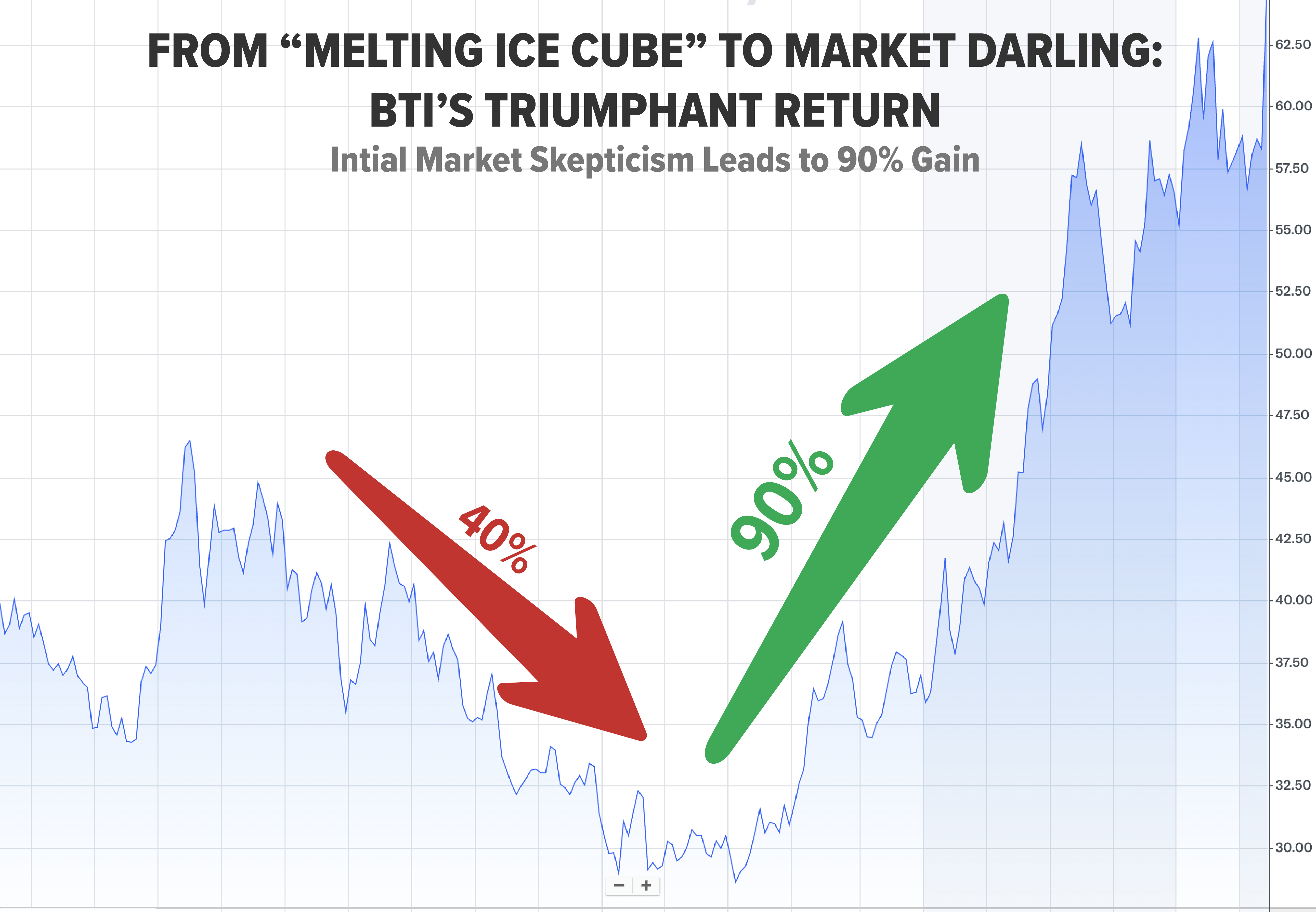
Two years ago, Wall Street wrote off British American Tobacco (BTI) as a “melting ice cube.” The stock had crashed 40% from its peak, and consensus said the business was dying.
We looked under the cover and realized they were wrong.
We alerted our subscribers, and BTI returned 90% in just 16 months.
Now if you had invested just $10,000 in BTI in June 2024, you’d be sitting on $19,000 in October 2025.
Today, we have identified a nearly identical pattern in a digital-first giant trading at $3.
While the market panics over a surface-level revenue decline, our PhD-led research shows management has actually surgically cut $100 million in waste to focus on high-margin growth.
This pattern is a hallmark of our 16.5% annual return track record. The current opportunity offers a 400% upside potential—dwarfing even our 90% BTI return.
Get the ticker for our new “Underdog” pick and the full BTI case study for just 99 cents.
This exclusive offer is for NEW newsletter subscribers ONLY! Join our Premium Readership Newsletter for only $0.99 and become part of a savvy investor community.!
This offer vanishes in 7 days, so don’t miss your chance to lock in market beating returns! Sign up NOW! The monthly newsletter comes with a 30-day, no-risk money-back guarantee. This offer is available to the first 1000 new investors who respond.
Here’s why this is a deal you can’t afford to pass up:
Access to our Detailed Report on this $3 stock with 400% upside potential.
BONUS REPORT on our #1 AI-Robotics Stock with 10000% upside potential: Our in-depth report dives deep into our #1 AI/robotics stock’s groundbreaking technology and massive growth potential.
One New Issue of Our Premium Readership Newsletter: You will also receive one new issue per month and at least one new stock pick per month from our monthly newsletter’s portfolio over the next 12 months. These stocks are handpicked by our research director, Dr. Inan Dogan.
One free upcoming issue of our 70+ page Quarterly Newsletter: A value of $149
Bonus Content: Premium access to members-only fund manager video interviews
Ad-Free Browsing: Enjoy a month of investment research free from distracting banner and pop-up ads, allowing you to focus on uncovering the next big opportunity.
Lifetime Price Guarantee: Your renewal rate will always remain the same as long as your subscription is active.
30-Day Money-Back Guarantee: If you’re not absolutely satisfied with our service, we’ll provide a full refund within 30 days, no questions asked.
Space is Limited! Only 1000 spots are available for this exclusive offer. Don’t let this chance slip away – subscribe to our Premium Readership Newsletter today and unlock the potential for a life-changing investment.
Here’s what to do next:
1. Head over to our website and subscribe to our Premium Readership Newsletter for just $0.99.
2. Enjoy a month of ad-free browsing, exclusive access to our in-depth report on the Trump tariff and nuclear energy company as well as the revolutionary AI-robotics company, and the upcoming issues of our Premium Readership Newsletter.
3. Sit back, relax, and know that you’re backed by our ironclad 30-day money-back guarantee.
Don’t miss out on this incredible opportunity! Subscribe now and take control of your AI investment future!