Markets

Insider Trading

Hedge Funds

Retirement

Opinion

1281292 - 11759070 - 1

Eli Lilly And Co (LLY): Is Former President Obama Bullish on This Stock Right Now?

We recently compiled a list of the Obama Stock Portfolio: 10 Year Returns. In this article, we are going to take a look at where Eli Lilly And Co (NYSE:LLY) stands against the other stocks in former U.S. president Barack Obama’s portfolio.

Former United States President Barack Obama took office during one of the worst recessions in U.S. history, yet the stock market reached new highs during his tenure. Stepping into office in 2009, the year after stocks plummeted nearly 40% amid the financial crisis of 2007-2008, Obama made a remarkably well-timed market prediction. On March 3, 2009, just days before the S&P 500 hit an intraday low of 666 and a closing low of 676.53, the then-president stated, “What you’re now seeing is profit-and-earnings ratios are starting to get to the point where buying stocks is a potentially good deal if you’ve got a long-term perspective on it.” By the time he left office on January 20, 2017, the S&P 500 had soared to 2,263.69, reflecting a gain of about 225% since his predictive remark.

The “Obama Years” coincided with rapid technological advancements that significantly impacted the stock market. Apple Inc.’s iPhone, introduced less than two years before he took office, exemplified this era of innovation. In addition, during Obama’s presidency, billionaire Reed Hastings transformed Netflix Inc. from a DVD rental-by-mail company into a video-streaming giant, revolutionizing entertainment consumption. On the other hand, renewable energy, particularly solar energy, struggled during the president’s tenure. Despite the administration’s solar subsidies, investors were largely disappointed as those subsidies eventually faded. First Solar Inc., one of the largest U.S. solar equipment producers, saw its stock plummet by as much as 74% due to falling solar panel prices, making it the worst-performing S&P 500 stock of the Obama era.

How Did the Obamas Make Their Money?

From speaking at events worldwide to writing memoirs and signing a major production deal with Netflix, the Obamas have led a busy and highly lucrative life post-White House. Michelle Obama’s first memoir, “Becoming,” published in November 2018, became that year’s No. 1 best-selling book. Her second book, “The Light We Carry: Overcoming in Uncertain Times,” also achieved bestseller status. Similarly, Barack Obama’s latest memoir, “A Promised Land,” sold nearly 890,000 copies within 24 hours of its November 2020 release. These ventures, along with the six-figure pension that all former presidents receive, have significantly boosted the Obamas’ net worth, which is at least $70 million according to the International Business Times. The New York Post, however, estimates their fortune to be much higher, at $135 million.

Of course, Barack Obama’s income isn’t limited to speaking fees and pensions. Like many other wealthy individuals, he has invested significantly in the stock market. So what does his portfolio look like? When he took office in 2009, Obama, like all presidents, was required to make financial disclosures by law. At that time, Obama held $200,000-$450,000 in the Vanguard 500 Index Fund Investor Shares that tracks the S&P 500 index, according to a report by CBS News.

Our Methodology

These investments were selected from the top holdings of the Vanguard 500 Index Fund Investor Shares, one of Barack Obama’s primary investments during his presidency, according to official disclosures. We have provided each stock’s trailing 10-year returns to assess their performance over the decade. Data from approximately 919 elite hedge funds tracked by Insider Monkey in the fourth quarter of 2024 was also analyzed to determine the number of hedge funds holding stakes in each firm.

Why are we interested in the stocks that hedge funds pile into? The reason is simple, our research has shown that we can outperform the market by imitating the top stock picks of best hedge funds. Our quarterly newsletter’s strategy picks 14 small and large-caps every quarter and it has returned 275% since May 2014, beating its benchmark by 150 percentage points (see more details here).

Note: The stocks are sorted in ascending order of their trailing 10-year returns.

An array of pharmaceutical pills with the company’s logo on the bottle.

Eli Lilly And Co (NYSE:LLY)

Number of Hedge Fund Investors: 109

Trailing 10-Year Returns: 30.06%

Founded in 1876, Eli Lilly and Company (NYSE:LLY) is a distinguished American pharmaceutical firm headquartered in Indianapolis, Indiana. Named after its founder, Colonel Eli Lilly, a pharmaceutical chemist and Civil War veteran, the company has established a global presence, operating in 18 additional countries.

Barclays recently reaffirmed its Overweight rating on Eli Lilly and Company (NYSE:LLY) with a consistent price target of $913.00. This positive outlook follows a generally favorable review of Eli Lilly’s Alzheimer’s drug, donanemab, by the Advisory Committee (AdCom) panel, with attention now turning to the regulatory agency’s decision on the drug’s finite dosing strategy. While donanemab’s impact on LLY’s shares might be limited, as it is considered secondary to the company’s broader GLP-1 narrative, its approval could significantly influence the Alzheimer’s drug market, especially in relation to competitor Biogen’s medication, Leqembi.

Eli Lilly and Company (NYSE:LLY) shares are currently trading at a P/E ratio of 131.56, significantly above its 5-year average of 48.69. This elevated valuation is supported by the potential of Eli Lilly and Company (NYSE:LLY)’s weight loss drugs, such as Mounjaro and Zepbound, and the strong market demand for weight loss medications.

As of the end of March 2024, Insider Monkey’s database revealed that 109 out of 919 hedge funds had invested in Eli Lilly and Company (NYSE:LLY). Among these investors, Ken Fisher’s Fisher Asset Management emerged as the company’s leading shareholder, with a stake valued at $3.65 billion.

Baron Health Care Fund stated the following regarding Eli Lilly and Company (NYSE:LLY) in its first quarter 2024 investor letter:

“Eli Lilly and Company (NYSE:LLY) is a global pharmaceutical company that discovers, develops, manufactures, and sells medicines in the categories of diabetes, oncology, neuroscience, and immunology, among other areas. Stock performance was strong due to robust fourth quarter sales of Mounjaro/ Zepbound, better-than-anticipated initial guidance for fiscal year 2024, and ongoing enthusiasm surrounding the company’s obesity and diabetes franchises. We continue to think Lilly is well positioned to grow revenue and earnings at attractive rates through the end of the decade and beyond.”

Overall LLY ranks 3rd on our list of former U.S. president Barack Obama’s portfolio stocks. You can visit Obama Stock Portfolio: 10 Year Returns to see the other stocks that are on hedge funds’ radar. While we acknowledge the potential of LLY as an investment, our conviction lies in the belief that AI stocks hold greater promise for delivering higher returns, and doing so within a shorter timeframe. If you are looking for an AI stock that is as promising than LLY but that trades at less than 5 times its earnings, check out our report about the cheapest AI stock.

Disclosure: None. This article is originally published at Insider Monkey.

The $250 Trillion AI Hype is Real. A few years from now, you’ll probably wish you’d bought this stock.

Dr. Inan Dogan

Dr. Ian Dogan

Co-Founder and Research Director at Insider Monkey

When Jeff Bezos said that one breakthrough technology would shape Amazon’s destiny, even Wall Street’s biggest analysts were caught off guard.

Fast forward a year and Amazon’s new CEO Andy Jassy described generative AI as a “once-in-a-lifetime” technology that is already being used across Amazon to reinvent customer experiences.

At the 8th Future Investment Initiative conference, Elon Musk predicted that by 2040 there would be at least 10 billion humanoid robots, with each priced between $20,000 and $25,000.

Do the math. According to Musk, this technology could be worth $250 trillion by 2040.

Put another way, that’s roughly equal to:

  • 175 Teslas
  • 107 Amazons
  • 140 Metas
  • 84 Googles
  • 65 Microsofts
  • And 55 Nvidias

And here’s the wild part — this $250 trillion wave isn’t tied to one company, but to an entire ecosystem of AI innovators set to reshape the global economy.

It’s a leap so massive, it could reshape how businesses, governments, and consumers operate worldwide.

Even if that $250 trillion figure sounds ambitious, major firms like PwC and McKinsey still see AI unlocking multi-trillion-dollar potential.

How could anything be worth that much?

The answer lies in a breakthrough so powerful it’s redefining how humanity works, learns, and creates.

And this breakthrough has already set off a frenzy among hedge funds and Wall Street’s top investors.

What most investors don’t realize is that one under-owned company holds the key to this $250 trillion revolution.

In fact, Verge argues this company’s supercheap AI technology should concern rivals.

Before I reveal the details, let’s talk about how some of the richest people on the planet are positioning themselves.

  • Bill Gates sees artificial intelligence as the “biggest technological advance in my lifetime,” more transformative than the internet or personal computer, capable of improving healthcare, education, and addressing climate change.
  • Larry Ellison — through Oracle, is spending billions on Nvidia chips and partnering with Cohere to embed generative AI across Oracle’s cloud and apps.
  • Warren Buffett — not known for tech hype — says this breakthrough could have a ‘hugely beneficial social impact.

When billionaires from Silicon Valley to Wall Street line up behind the same idea — you know it’s worth paying attention to.

Even as we admire what Tesla, Nvidia, Alphabet, and Microsoft have built, we believe an even greater opportunity lies elsewhere…

But the real story isn’t Nvidia — it’s a much smaller company quietly improving the critical technology that makes this entire revolution possible.

And judging by what I’m hearing from both Silicon Valley insiders and Wall Street veterans…

This prediction might not be bold at all:

A few years from now, you’ll wish you’d owned this stock.

The best part? You can discover everything about this company and its groundbreaking technology right now.

I’ve compiled everything you need to know about this groundbreaking company in a detailed, members-only report.

Trust me — you’ll want to read this report before putting another dollar into any tech stock.

For a ridiculously low price of just $9.99 a month, you can unlock a year’s worth of in-depth investment research and exclusive insights – that’s less than a single fast food meal!

Here’s what to do next:

1. Subscribe to our Premium Readership Newsletter for just $9.99 a month. (33% Off – was $14.99).

2. Enjoy a year of ad-free browsing, exclusive access to our in-depth report on the revolutionary AI company, and the upcoming issues of our Premium Readership Newsletter over the next 12 months.

3. Sit back, relax, and know that you’re backed by our ironclad 30-day money-back guarantee.

Don’t miss out on this incredible opportunity! Subscribe now and take control of your AI investment future!

No worries about auto-renewals! Our 30-Day Money-Back Guarantee applies whether you’re joining us for the first time or renewing your subscription a month later!


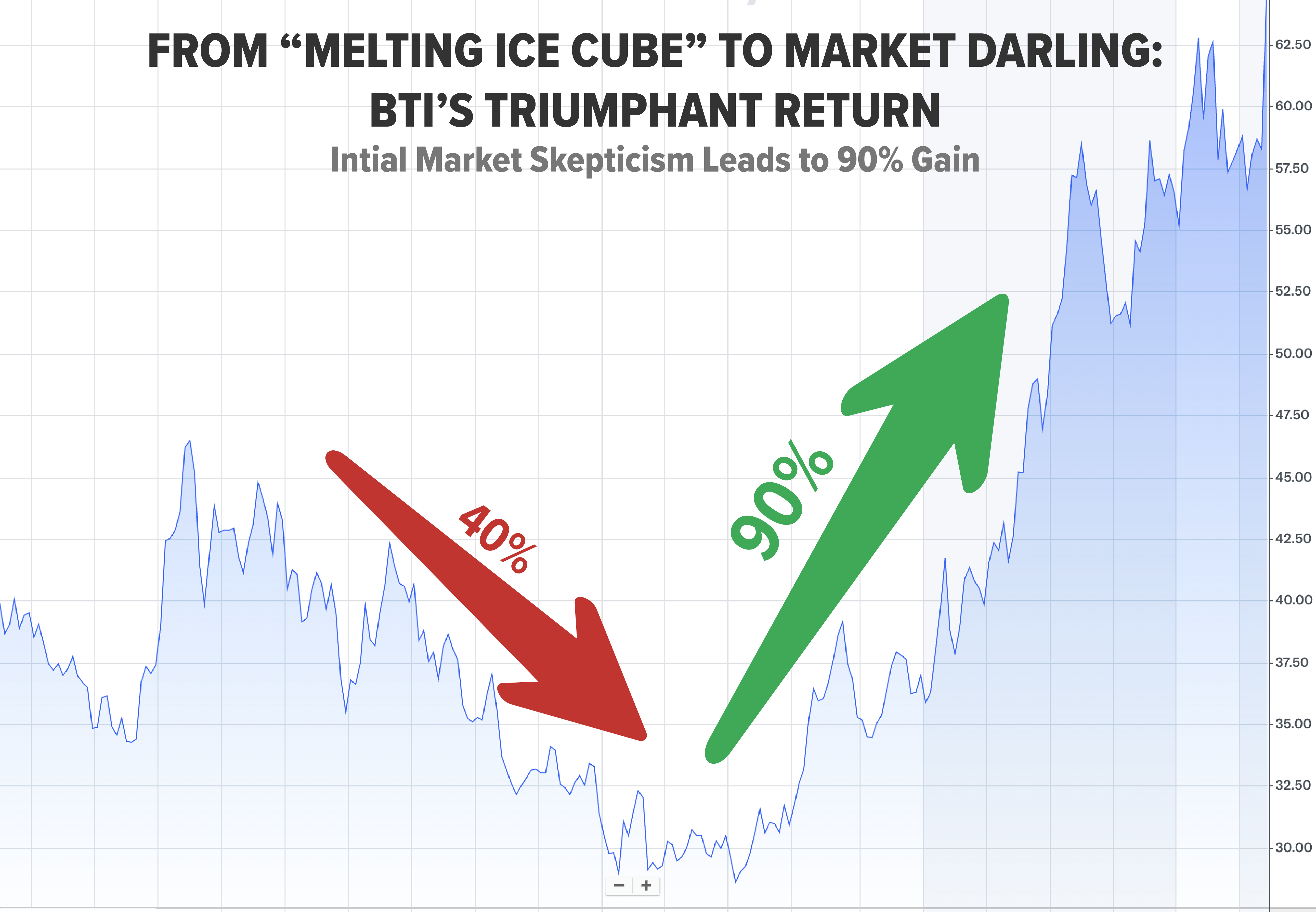
Wall Street calls this $3 stock a “Melting Ice Cube.” They said the same thing about BTI before it returned 90%.

Dr. Inan Dogan

Dr. Ian Dogan

Co-Founder and Research Director at Insider Monkey

My name is Inan Dogan. I’m the co-founder and Research Director of Insider Monkey. I have an important message for you today.

Since March 2017, my stock picks have returned 16.5% annually. Today, I’ve found an opportunity even bigger than my British American Tobacco call.

Two years ago, Wall Street wrote off British American Tobacco (BTI) as a “melting ice cube.” The stock had crashed 40% from its peak, and consensus said the business was dying.

We looked under the cover and realized they were wrong.

We alerted our subscribers, and BTI returned 90% in just 16 months.

Now if you had invested just $10,000 in BTI in June 2024, you’d be sitting on $19,000 in October 2025.

Today, we have identified a nearly identical pattern in a digital-first giant trading at $3.

While the market panics over a surface-level revenue decline, our PhD-led research shows management has actually surgically cut $100 million in waste to focus on high-margin growth.

This pattern is a hallmark of our 16.5% annual return track record. The current opportunity offers a 400% upside potential—dwarfing even our 90% BTI return.

Get the ticker for our new “Underdog” pick and the full BTI case study for just 99 cents.

This exclusive offer is for NEW newsletter subscribers ONLY! Join our Premium Readership Newsletter for only $0.99 and become part of a savvy investor community.!

This offer vanishes in 7 days, so don’t miss your chance to lock in market beating returnsSign up NOW! The monthly newsletter comes with a 30-day, no-risk money-back guarantee. This offer is available to the first 1000 new investors who respond.

Regular price $9.99/mo. Cancel anytime.

Space is Limited! Only 1000 spots are available for this exclusive offer. Don’t let this chance slip away – subscribe to our Premium Readership Newsletter today and unlock the potential for a life-changing investment.

Here’s what to do next:

1. Head over to our website and subscribe to our Premium Readership Newsletter for just $0.99.

2. Enjoy a month of ad-free browsing, exclusive access to our in-depth report on the Trump tariff and nuclear energy company as well as the revolutionary AI-robotics company, and the upcoming issues of our Premium Readership Newsletter.

3. Sit back, relax, and know that you’re backed by our ironclad 30-day money-back guarantee.

Don’t miss out on this incredible opportunity! Subscribe now and take control of your AI investment future!

Regular price $9.99/mo. Cancel anytime.