Markets

Insider Trading

Hedge Funds

Retirement

Opinion

1281292 - 11759070 - 1

Did Arbor Realty Trust, Inc. (ABR) Demonstrate Financial Stability in Q1?

We recently compiled a list of What Is Short Selling In Stock Market? 15 Stocks Hedge Funds are Shorting. In this article, we are going to take a look at where Arbor Realty Trust, Inc. (NYSE:ABR) stands against the other stocks hedge funds are shorting.

Short selling, also known as shorting or going short, is a trading method in which assets are borrowed and subsequently sold in order to profit from the stock’s decline in price. Investors borrow securities from brokers and sell them on the open market to carry out a short sale. The investor can purchase the asset back at a reduced price, return it to the broker, and keep the difference as profit if the price of the security drops. If the price increases, the investor will have to pay more for the security and will suffer a loss. Hedge funds and institutional investors make the majority of conventional short sales or bets that a stock price will drop to protect their interests from falling stock prices or to speculate that shares are overpriced. On the other hand, activist short sellers investigate companies to identify targets they claim have questionable accounting or business procedures, distribute information (often in secret), and, if all goes according to plan, drive down the share price. Columbia University law professor Joshua Mitts’ 2019 research, Short and Distort, discovered more than $20 billion in stock mispricing related to hundreds of anonymous attacks on public businesses between 2010 and 2017.

The S&P 500 has increased by 15% so far this year, which is indicative of a strong market performance. As a result, short sellers for the 500 companies in the index have faced difficulties and possible losses rather than being in the winners’ circle. The amount of short interest in an average S&P 500 member is at its lowest point in almost twenty years, according to Goldman Sachs Group Inc. HFR statistics stated assets in funds with a short bias fell to $4.6 billion from $7.8 billion in 2008, during a time when the total size of equity hedge funds almost tripled in size. In the US, the Securities and Exchange Commission (SEC) regulates short selling to guard against misuse and ensure that it continues to benefit the market during sharp declines in stock prices.

In 2023, the SEC adopted new regulations to promote transparency in short-selling, mandating investors to record short positions and companies to submit records of share lending activity to FINRA, a self-regulatory body that polices brokers. In the aftermath of the Video Game Retailer controversy, short sellers had lost over $6 billion, according to analytics company S3 Partners, as a result of retail investors pushing up the stock price. Hence, short selling came under renewed congressional scrutiny in 2021.

However, hedge funds represented by the Managed Funds Association stated that the restrictions may disclose investors’ methods. “Investment advisers will face more risk when selling short, which will harm investors, market participants, and market efficiency,” Bryan Corbett, its chief executive officer, warned.

Despite the challenges that short sellers face, there are several advantages to short selling for both the economy and the capital markets. Research from both theoretical and empirical perspectives has demonstrated that short selling improves price efficiency, liquidity, and corporate governance, hence improving the overall state of the market.

According to statistics from S3 Partners, the Commercial Banking Company’s failure made it the most successful short bet of the year, producing paper profits of $1.6 billion. In second place was the Pharmaceutical and Biotechnology Company, a maker of vaccines, which fell 45% in 2023. Short sellers, who bet on the stock’s collapse, made $1.1 billion from this company.

However, short sellers faced significant losses by betting on mega-cap technology businesses, which rose in 2023 and drove a wide comeback in stocks. The E-Mobility King caused the greatest agony for short sellers, incurring $12.2 billion in paper losses in 2023 as the electric car maker’s price almost doubled. AI Chipmaker, which lost $11.2 billion to bearish traders, was next on the list, which included the majority of the so-called Magnificent Seven, semiconductor giants, and Coinbase, as bitcoin rebounded. The previous year was brutal for the market. As per S3 Partners’ research, short sellers on Wall Street have lost around $195 billion so far this year, which almost balances out the nearly $300 billion in gains they experienced during the 2022 market crisis. In total, the group lost $242 billion in 2020 and around $142 billion in 2021. Although short selling carries risk, investors may be able to lower this risk and make profits by keeping an eye on equities that hedge funds are shorting.

Methodology:

For our list of stocks that hedge funds are shorting, we picked stocks with institutional ownership (which also includes hedge funds) of over 40% and float shorted over 30%. We curated our list based on institutional-ownership percentage.

Why are we interested in the stocks that hedge funds pile into? The reason is simple: our research has shown that we can outperform the market by imitating the top stock picks of the best hedge funds. Our quarterly newsletter’s strategy selects 14 small-cap and large-cap stocks every quarter and has returned 275% since May 2014, beating its benchmark by 150 percentage points. (see more details here)

Rows of neatly arranged, multi-family homes, symbolizing the company’s large-scale investing opportunities.

Arbor Realty Trust, Inc. (NYSE:ABR)

% of Institutional Ownership: 61.76%

Float Shorted: 39.28%    

Arbor Realty Trust, Inc. owns a diverse portfolio of structured financing assets in the multifamily, single-family rental, and commercial real estate sectors in the United States. Arbor Realty Trust’s hedge funds are shorting 31.55%, and it has 62.38% institutional ownership as of June 20. 

Q1 2024 GAAP net income for Arbor Realty Trust was $57.9 million ($0.31 per share), down from Q1 2023’s $84.3 million. This decline was mainly caused by reduced sales from the company’s agency business, which brought in $66.6 million as opposed to $96.3 million in the previous year. In spite of this, $96.7 million in distributable earnings ($0.47 per share) represented strong results.

The company has demonstrated its financial stability with a 9% rise in its loan servicing portfolio to $31.38 billion and strong liquidity, with $800 million in cash and $600 million in restricted cash. A steady dividend payment ratio of 91%, strategic stock repurchases at a discount, and an expanding loan servicing portfolio that demonstrates investor trust are some of Arbor’s strengths.

At the end of the first quarter of 2024, 24 hedge funds monitored by Insider Monkey reported having shares in Arbor Realty Trust, Inc. (NYSE:ABR), up from 17 the previous quarter. With 3,170,000 shares valued at $42 million, Christopher R. Hansen’s Valiant Capital was the company’s largest shareholder in the first quarter.

Overall ABR ranks 13th on our list of the 15 stocks hedge funds are shorting. You can visit What Is Short Selling In Stock Market? 15 Stocks Hedge Funds are Shorting to see the other stocks that are on hedge funds’ radar. While we acknowledge the potential of ABR as an investment, our conviction lies in the belief that AI stocks hold greater promise for delivering higher returns, and doing so within a shorter timeframe. If you are looking for an AI stock that is more promising than ABR but that trades at less than 5 times its earnings, check out our report about the cheapest AI stock.

READ NEXT: Analyst Sees a New $25 Billion “Opportunity” for NVIDIA and Jim Cramer is Recommending These 10 Stocks in June.

Disclosure: None. This article is originally published at Insider Monkey.

The $250 Trillion AI Hype is Real. A few years from now, you’ll probably wish you’d bought this stock.

Dr. Inan Dogan

Dr. Ian Dogan

Co-Founder and Research Director at Insider Monkey

When Jeff Bezos said that one breakthrough technology would shape Amazon’s destiny, even Wall Street’s biggest analysts were caught off guard.

Fast forward a year and Amazon’s new CEO Andy Jassy described generative AI as a “once-in-a-lifetime” technology that is already being used across Amazon to reinvent customer experiences.

At the 8th Future Investment Initiative conference, Elon Musk predicted that by 2040 there would be at least 10 billion humanoid robots, with each priced between $20,000 and $25,000.

Do the math. According to Musk, this technology could be worth $250 trillion by 2040.

Put another way, that’s roughly equal to:

  • 175 Teslas
  • 107 Amazons
  • 140 Metas
  • 84 Googles
  • 65 Microsofts
  • And 55 Nvidias

And here’s the wild part — this $250 trillion wave isn’t tied to one company, but to an entire ecosystem of AI innovators set to reshape the global economy.

It’s a leap so massive, it could reshape how businesses, governments, and consumers operate worldwide.

Even if that $250 trillion figure sounds ambitious, major firms like PwC and McKinsey still see AI unlocking multi-trillion-dollar potential.

How could anything be worth that much?

The answer lies in a breakthrough so powerful it’s redefining how humanity works, learns, and creates.

And this breakthrough has already set off a frenzy among hedge funds and Wall Street’s top investors.

What most investors don’t realize is that one under-owned company holds the key to this $250 trillion revolution.

In fact, Verge argues this company’s supercheap AI technology should concern rivals.

Before I reveal the details, let’s talk about how some of the richest people on the planet are positioning themselves.

  • Bill Gates sees artificial intelligence as the “biggest technological advance in my lifetime,” more transformative than the internet or personal computer, capable of improving healthcare, education, and addressing climate change.
  • Larry Ellison — through Oracle, is spending billions on Nvidia chips and partnering with Cohere to embed generative AI across Oracle’s cloud and apps.
  • Warren Buffett — not known for tech hype — says this breakthrough could have a ‘hugely beneficial social impact.

When billionaires from Silicon Valley to Wall Street line up behind the same idea — you know it’s worth paying attention to.

Even as we admire what Tesla, Nvidia, Alphabet, and Microsoft have built, we believe an even greater opportunity lies elsewhere…

But the real story isn’t Nvidia — it’s a much smaller company quietly improving the critical technology that makes this entire revolution possible.

And judging by what I’m hearing from both Silicon Valley insiders and Wall Street veterans…

This prediction might not be bold at all:

A few years from now, you’ll wish you’d owned this stock.

The best part? You can discover everything about this company and its groundbreaking technology right now.

I’ve compiled everything you need to know about this groundbreaking company in a detailed, members-only report.

Trust me — you’ll want to read this report before putting another dollar into any tech stock.

For a ridiculously low price of just $9.99 a month, you can unlock a year’s worth of in-depth investment research and exclusive insights – that’s less than a single fast food meal!

Here’s what to do next:

1. Subscribe to our Premium Readership Newsletter for just $9.99 a month. (33% Off – was $14.99).

2. Enjoy a year of ad-free browsing, exclusive access to our in-depth report on the revolutionary AI company, and the upcoming issues of our Premium Readership Newsletter over the next 12 months.

3. Sit back, relax, and know that you’re backed by our ironclad 30-day money-back guarantee.

Don’t miss out on this incredible opportunity! Subscribe now and take control of your AI investment future!

No worries about auto-renewals! Our 30-Day Money-Back Guarantee applies whether you’re joining us for the first time or renewing your subscription a month later!


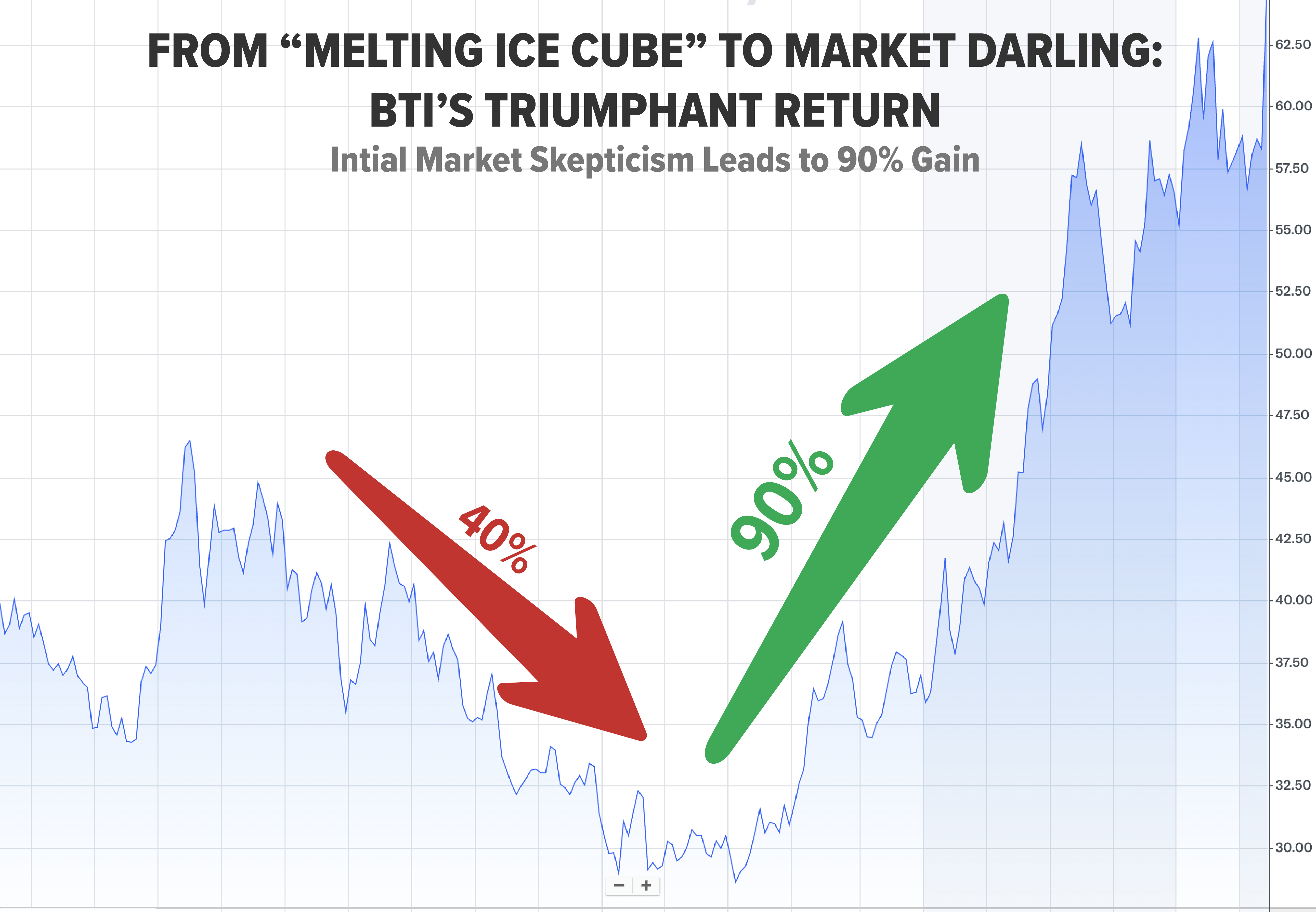
Wall Street calls this $3 stock a “Melting Ice Cube.” They said the same thing about BTI before it returned 90%.

Dr. Inan Dogan

Dr. Ian Dogan

Co-Founder and Research Director at Insider Monkey

My name is Inan Dogan. I’m the co-founder and Research Director of Insider Monkey. I have an important message for you today.

Since March 2017, my stock picks have returned 16.5% annually. Today, I’ve found an opportunity even bigger than my British American Tobacco call.

Two years ago, Wall Street wrote off British American Tobacco (BTI) as a “melting ice cube.” The stock had crashed 40% from its peak, and consensus said the business was dying.

We looked under the cover and realized they were wrong.

We alerted our subscribers, and BTI returned 90% in just 16 months.

Now if you had invested just $10,000 in BTI in June 2024, you’d be sitting on $19,000 in October 2025.

Today, we have identified a nearly identical pattern in a digital-first giant trading at $3.

While the market panics over a surface-level revenue decline, our PhD-led research shows management has actually surgically cut $100 million in waste to focus on high-margin growth.

This pattern is a hallmark of our 16.5% annual return track record. The current opportunity offers a 400% upside potential—dwarfing even our 90% BTI return.

Get the ticker for our new “Underdog” pick and the full BTI case study for just 99 cents.

This exclusive offer is for NEW newsletter subscribers ONLY! Join our Premium Readership Newsletter for only $0.99 and become part of a savvy investor community.!

This offer vanishes in 7 days, so don’t miss your chance to lock in market beating returnsSign up NOW! The monthly newsletter comes with a 30-day, no-risk money-back guarantee. This offer is available to the first 1000 new investors who respond.

Regular price $9.99/mo. Cancel anytime.

Space is Limited! Only 1000 spots are available for this exclusive offer. Don’t let this chance slip away – subscribe to our Premium Readership Newsletter today and unlock the potential for a life-changing investment.

Here’s what to do next:

1. Head over to our website and subscribe to our Premium Readership Newsletter for just $0.99.

2. Enjoy a month of ad-free browsing, exclusive access to our in-depth report on the Trump tariff and nuclear energy company as well as the revolutionary AI-robotics company, and the upcoming issues of our Premium Readership Newsletter.

3. Sit back, relax, and know that you’re backed by our ironclad 30-day money-back guarantee.

Don’t miss out on this incredible opportunity! Subscribe now and take control of your AI investment future!

Regular price $9.99/mo. Cancel anytime.